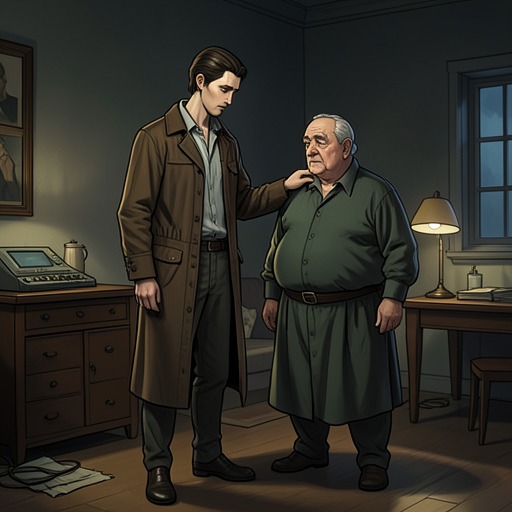
Mrs. Burbridge
The LighthouseMrs. Burbridge is the housekeeper of Combe House and a quiet center of its domestic life. Her authority rests less on commands than on an unspoken confidence that her arrangements will be accepted; as danger reaches the island, that same command of routine makes her a practical presence amid uncertainty.
Identity and Household Authority
When Rupert Maycroft introduces the people who will assist the investigation, he identifies Mrs. Burbridge as the housekeeper in charge of all domestic arrangements. She sits through the introduction rather than rising, and her brief smile is considered and conditional. The restraint suits the authority Dalgliesh observes in her: she is upright and still, her hands resting unclasped, her steel-grey hair braided and pinned into a bun. Silver-rimmed spectacles frame sharp, questioning eyes. Her firm mouth and composed posture suggest a woman who does not need to insist on her position because she scarcely imagines it will be challenged.
That impression is not simply a matter of appearance. Mrs. Burbridge belongs to the island’s working household, where meals, rooms, and supplies have to be managed alongside the formal business of the trust. Her authority is domestic, but it carries practical knowledge: she knows what food is available, who has been asked to deliver it, and how the household can continue to function when ordinary arrangements become difficult.
A Keeper of Domestic Information
The investigation into the note intended for Nathan Oliver brings that knowledge into focus. Millie Tranter remembers receiving a note from Dr. Speidel before tea, but the time remains imprecise. Mrs. Burbridge supplies a more exact sequence. Dr. Speidel had telephoned to say that he would miss dinner because he felt unwell, and had asked for soup to heat and some whisky. While Millie was helping in the kitchen, Mrs. Burbridge went to speak with Mrs. Plunkett about the soup. She knew that soup was usually available and that the previous day’s chicken soup was homemade. Millie then offered to take the food to Shearwater Cottage in the buggy, leaving at about three o’clock.
Her account does more than fill a gap in Millie’s memory: it places the delivery within the ordinary work of the kitchen. Soup, a request by telephone, and a familiar errand establish when Millie was in a position to receive and carry the note. Mrs. Burbridge does not solve the mystery herself, but her close attention to household routine gives the investigators a firmer chronology than a general recollection of the afternoon could provide.
Care, Supplies, and Collaboration
Mrs. Burbridge’s domestic work also intersects with care. When asked whether medicines might be missing from the surgery, Jo Staveley explains that supplies had been needed while Martha Padgett was being nursed and that Mrs. Burbridge had occasionally helped, taking what was required. The medicines were not locked away. This makes Mrs. Burbridge part of the history of informal assistance around the sickroom, while also complicating any assumption that the absence of a supply would necessarily have been noticed. Jo is clear that no drugs have been found, and that any such drugs would not have come from the surgery.
Later, with a murderer still at large and a potentially fatal illness threatening the island, Mrs. Burbridge turns again to the work she knows. She asks what the investigators want for supper and whether it should be delivered to Seal Cottage. For Kate Miskin, eating at the house where Dalgliesh had been seated would make his absence painfully present. She chooses to stay in her small stable-block apartment instead. The contrast is telling: Mrs. Burbridge offers food and delivery as a means of keeping the household going, while Kate’s refusal shows that a meal in the familiar dining room has acquired an emotional weight routine cannot remove.
Poise in the Lighthouse Crisis
Mrs. Burbridge’s composure is tested when the pursuit of Dan Padgett reaches the lighthouse. After Emily Holcombe asks where Padgett is, she learns that he has Millie Tranter with him. Mrs. Burbridge immediately asks whether he murdered Adrian Boyde. Kate does not answer; she tells those present to remain calm and follow her instructions. The question shows Mrs. Burbridge grasping the danger’s connection to the killing, even as the investigation has not yet given her a full explanation.
Then Millie’s scream cuts across the scene. Padgett has lifted her over the gallery rail onto a ledge only six inches wide and is edging her toward the seaward curve of the lighthouse while holding her by the arm. Mrs. Burbridge lets out a moan and sinks down with her face in her hands. Her reaction breaks the stillness that marked her first appearance: the woman who had seemed to command herself and her surroundings cannot remain composed before the immediate spectacle of Millie’s peril. The change is not a loss of concern but its visible cost.
Care Beyond the Immediate Emergency
Mrs. Burbridge’s care extends to the small accommodations that make island life bearable. In her sewing room, Kate says that she would like a change for the evening, despite having brought enough clothes and knowing it would be unreasonable to expect more to arrive by helicopter. Mrs. Burbridge offers to make her a shirt from a length of subtle sea-green silk, choosing a color she thinks will suit Kate. She completes it in two days. When Kate wears it, she notices the men’s appreciative glances and Mrs. Burbridge’s satisfied smile; Kate suspects the housekeeper has detected or imagined a romantic interest in Rupert Maycroft and is engaging in gentle matchmaking.
The episode joins practical skill to social attentiveness. Mrs. Burbridge can respond to a shortage of clothing with needlework, but she also reads the people around her and takes pleasure in the possibility of romance. Her generosity is specific rather than grand: a length of fabric, two days’ work, and a new shirt that allows Kate to enter the evening gathering differently.
Her concern for the island’s future likewise appears through domestic conversation. Mrs. Plunkett tells Kate that Mrs. Burbridge had proposed welcoming overworked city clergymen to Combe as a memorial to Adrian Boyde. Emily Holcombe rejects the idea, imagining that such visitors would be young and enthusiastic about modern worship, whereas she remains devoted to the Book of Common Prayer. Mrs. Burbridge’s suggestion is reported rather than debated directly, but it places her among those considering what the island might become after the crisis. Across these episodes, her characteristic contribution is to make care tangible: a meal, needed supplies, a well-timed recollection, a shirt, or an idea for future hospitality.